9/11 Perspectives Take Center Stage At School-Wide Assembly
At the very center of historical study lies a huge question: How do you preserve the spirit of a life-altering moment for people who weren’t around to experience it themselves? On Friday, September 11th, 2026, the Camden High School Social Studies department provided an answer to that question. As part of a school-wide remembrance assembly, students at Camden High learned about the tragic events that occurred exactly 25 years prior through the eyes of staff members and guests.
The stated goal of the assembly was not only to recount the tragic events from a variety of perspectives, but to also emphasize the courage displayed, showcase the renewed commitment to service and unity across the country in the aftermath, and demonstrate the ongoing importance of civic action.
To open the program, senior Luke Eveleth led the audience in the pledge of allegiance, and the CHS Choir Select Ensemble including Mikinzie Collins, Annabelle Segur, and Drew Collins performed the national anthem.
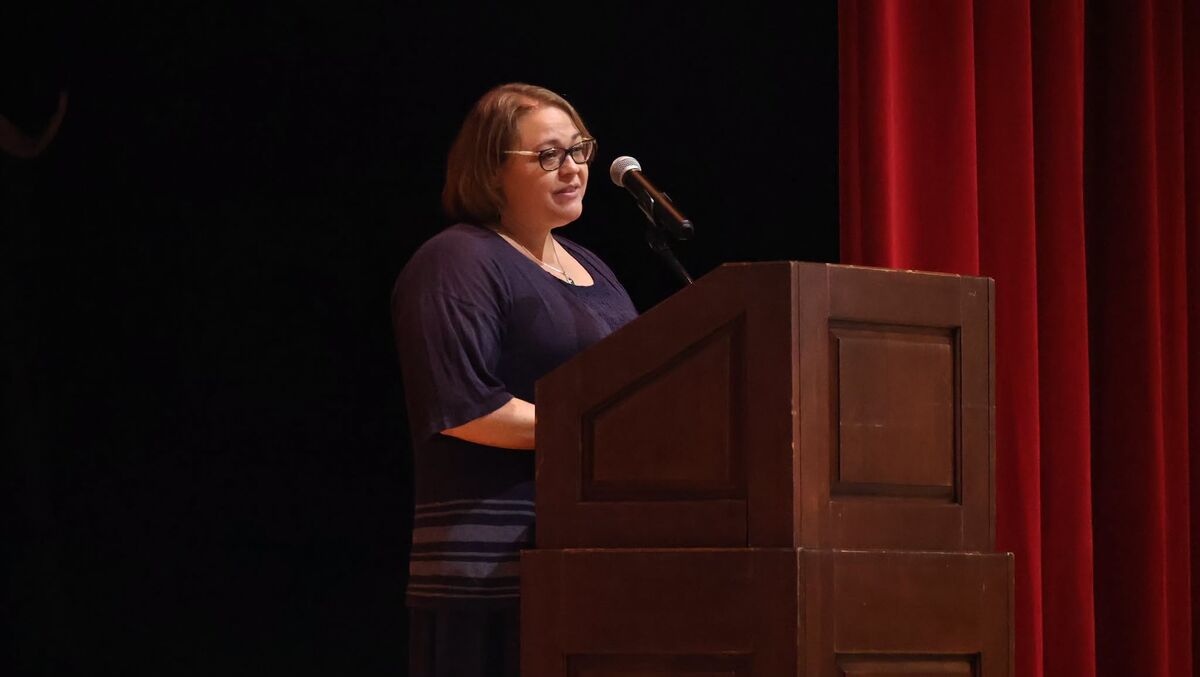
Social Studies teacher Karen Davis, now in her 26th year of teaching at Camden, approached her remarks from the viewpoint of a first year teacher, as she was on that fateful day.
“September 11th started out as any other day,” she said. “It was a beautiful, sunny Tuesday morning without a cloud in the sky. It was the beginning of my teaching career here at Camden High School, and I was in the midst of teaching Global Nine when Mrs. Sue Hite, the secretary at the time, came running down the hallway, banged on my door, and said a plane just crashed into the World Trade Center. That is the moment that everything changed. And for an instant, it felt as if time had stopped. So many questions without answers. Was this an accident or intentional? Who could have done this and why? Are my friends at work in the Twin Towers or have they not arrived for the day yet? As a teacher, a new teacher at that, I was faced with keeping calm and remaining steady for all of these young faces before me, while all of these thoughts and emotions were filling my head.”
Davis later transposed the moment into the present for her attentive audience.
“...These are the moments that we hear and learn about, but it's important to remember that all Americans were impacted that day. Somehow, someway, everybody has a story and it's important to hear and listen to those individual stories. It is very possible that your mom, dad, aunt or uncle was sitting in the classroom with me that day watching as these events transpired. No one really knew what was happening, what was going to happen next or even what this meant for our country and the world.”
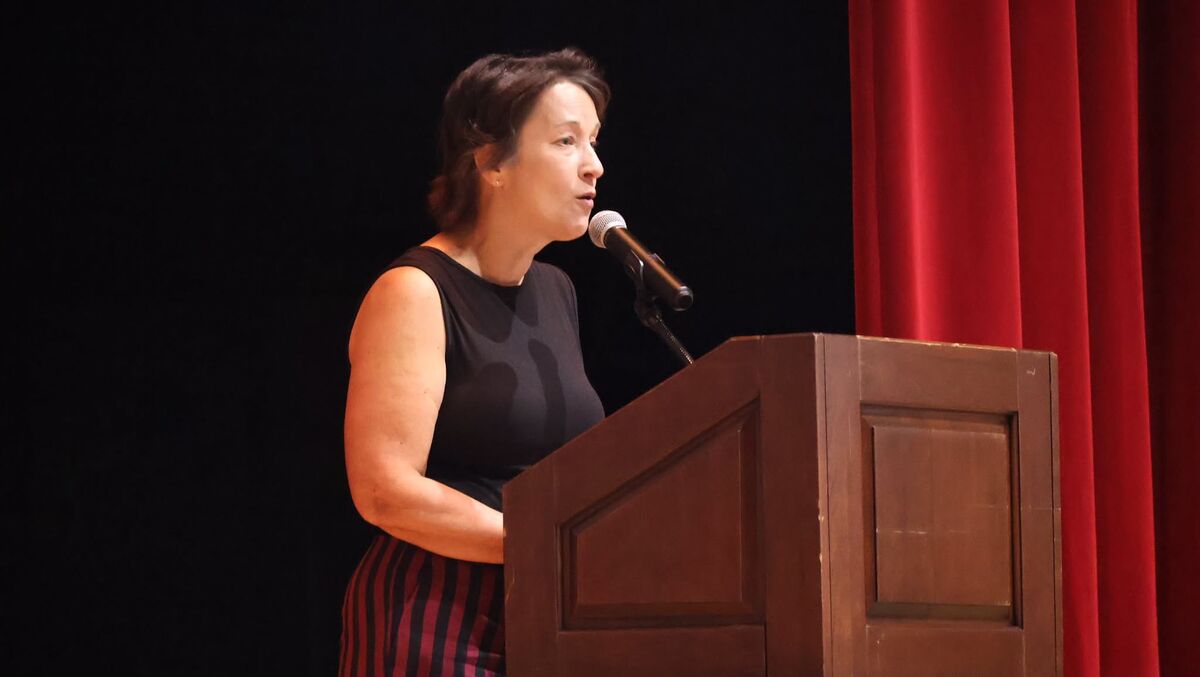
After a short video presentation, guest speaker Amy Robbins took the stage. Amy, a 1983 graduate of Camden High School, has been one of the preeminent voices in the Syracuse Radio market for decades as the co-host of 93Q’s “Ted and Amy In The Morning”. In 2019, she was enshrined in the New York State Broadcasters’ Association Hall of Fame.
Wedged in that Hall of Fame career was September 11th, 2001, where Robbins had to shift gears quickly between the fun of a radio morning show, to the seriousness of the events unfolding in New York, Washington DC, and Pennsylvania. And do so seamlessly to an audience that trusted her.
“I'd been working at 93Q for about 13 years at that point,” she said. “I'd just gone into our office from the radio studio and the radio was on a news station because I would listen to it before I would come on the air to see if I was missing anything. And I heard that a plane had struck the World Trade Center in New York City. My first thought was it was a small private plane that had some sort of engine trouble and had crashed, unfortunately, into a really tall building. So we started monitoring the TV station in the studio, and about 10 minutes later, we went on the air and reported what we knew. And that's when the second plane hit. And all of a sudden, it wasn't just a fluke anymore. It turned really real, really fast.”
The feeling didn’t just stay on that day, but permeated into the weeks and months that followed.
“Our specialty was kind of making people laugh and be happy,” she said. And on September 11, 2001, that day changed our show for a long time. Nobody wanted to laugh or feel good. It was such a strange sensation being attacked so close to home…. We were all kind of in shock that first week, but I remember coming home that first day, and I could not stop crying. I didn't know anyone personally, but I, like so many, was heartbroken. I was also overwhelmed with the responsibility I felt being on the air…. It was no longer entertaining people. It was informing them. It was finding experts to interview about what happened, how it happened, why it happened. Nobody wanted to laugh or feel good or play a contest. So our show just changed so much, much rather, for months after the attack.”
While the show took on a different tone, Robbins knew her responsibility was as important as ever.
“I feel like so many people tuned in, not so much because we were the latest and the greatest when it came to news coverage, but when you're hurting, you want to feel something familiar and comfortable,” she said. “And so many said that in those darkest hours, just to be able to turn on the radio and hear something normal, voices that you knew were not going anywhere, that were really familiar and that you could trust, it gave them so much comfort. And that gave me the comfort and the confidence to do the best that I could.”
Robbins also offered up a story of one of the many emergent heroes from that day - Charles “Chuck” Costello Jr.
Costello was a father of four from New Jersey, a Navy Veteran, and most important to the story: An elevator mechanic. He was working at a hotel in Soho at the time of the attacks, and ran in the direction of danger to use his knowledge of elevator systems to save the lives of many who were trapped inside the World Trade Center elevators. He sacrificed his own life to save hundreds who would have never made it out otherwise.
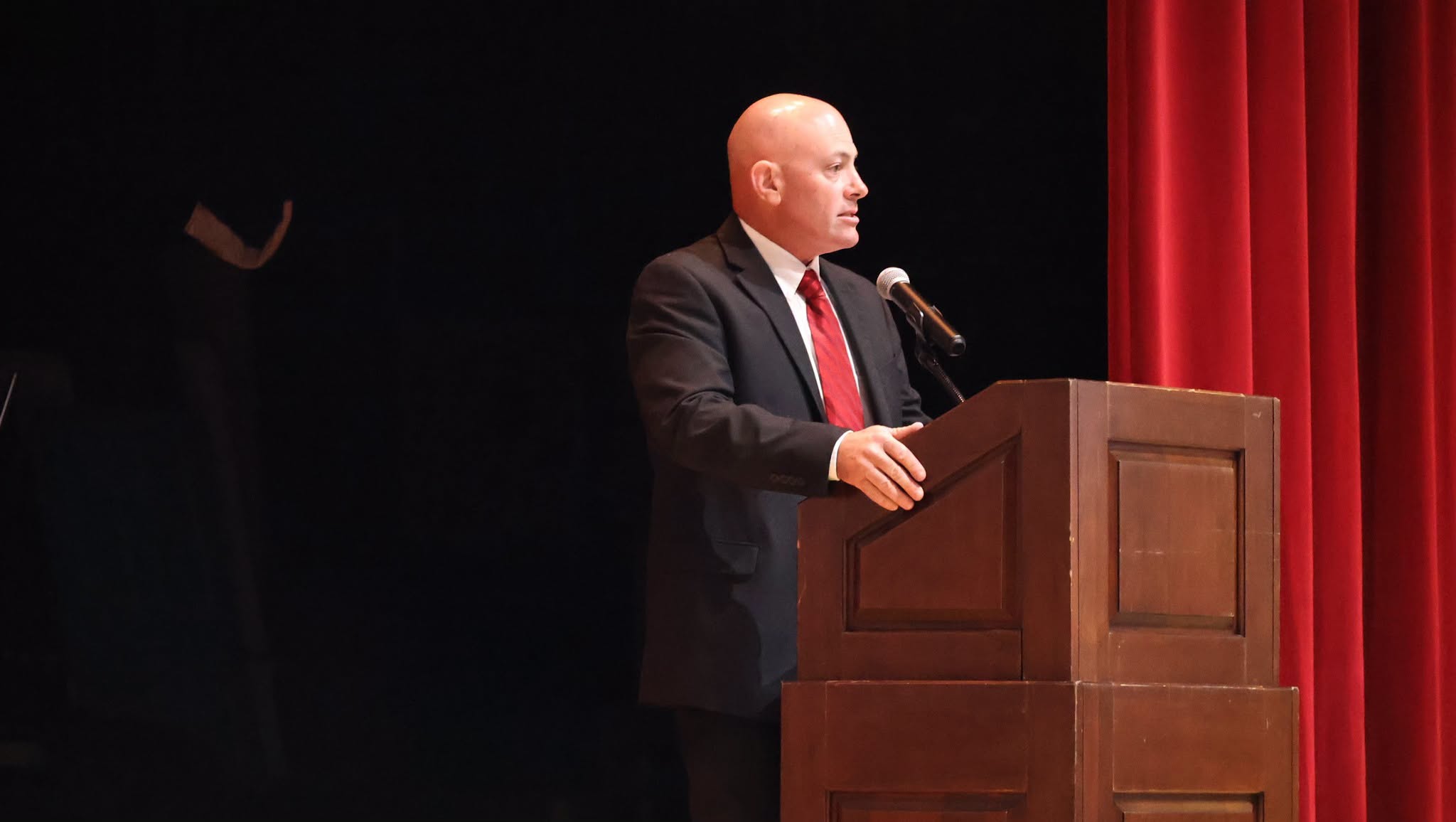
Then it was time for arguably the most powerful address of the day - from a face familiar to so many. School Patrol Officer Dustin Hite ‘92 has worn many hats including firefighter, EMT, policeman, father, husband, and coach, but his career was with the New York State Police. He was eating breakfast after a late shift as a young Trooper, watching NBC’s “Today Show” when the events began to unfold.
“Shortly after that, my phone started ringing,” he said. “It was work calling to see how soon I could go to New York City.”
Hite and other Troopers across the state packed their bags and prepared to go whenever they were called. They met at designated points to be transported into New York City for what was the most historically significant assignment of many careers.
About ten days later, Hite’s day came and he was en route to the staging area at the Javits Convention Center in Manhattan.
“By the time I got to go, the first crews had already been there in New York City for 10 days with just a backpack full of clothes that they had grabbed on the first day, not having a clue how long their stay would be.”
It was his first trip to the city, and to say that it was an overwhelming introduction may be an understatement.
“It was intense, it was serious, it was chaotic,” he said. “It was the first time I had ever been to New York City. The city was overwhelming, it was giant, but had been brought to its knees in a blink of an eye. The first night we entered the city, you could see the huge lights set up around ground zero. The smell was awful. Everything burned. The smells were just unimaginable, questionable. There was no power in most of lower Manhattan. It was just an odd sort of quiet that you would not expect in the largest city in America.”
His first assignment was traffic control on one of the streets that led to Ground Zero. He worked 12 hours a day, seven days a week on alternating weeks. While he was never assigned to the cleanup, he did describe in vivid detail the simultaneous horror and triumph of the human spirit that he saw around the site. Steel beams melted and twisted like toothpicks. Dust everywhere. And above it all, the people who worked night and day to clean up the mess and re-unite loved ones with even the slightest portion of their loved ones’ time on earth.
“I would like to recognize that for all the men and women and the dogs who stayed for months digging through the rubble,” he said. “It took a lot of courage and hard work to continue to have the drive to find a single sign of life or any type of remain. This was a service to the families of the deceased so they could have some part of their loved one back. It was exhausting, emotionally straining for many to continue to search day after day. I'm grateful for their dedication.”
Hite continued his work over a six month period. In addition to traffic management, he also did stints patrolling the Brooklyn Bridge, and checking vehicles for explosives at the bridges and tunnels. Amidst the long days, he made the best of it. He made friends with the delivery drivers he was encountering on inspection detail. He learned how to nap in the back of a police car. He learned that milk helps alleviate cramping due to exhaust fumes. And he saw the kindness of New Yorkers firsthand over and over again.
Yet, he still thinks about the massive human cost that has befallen many he knew.
23 members of NYPD died on the day of the attacks. Since, 469 additional officers have perished because of related illnesses. 343 firefighters died on 9/11, and since, 603 more have perished from related complications as recently as last week. While the New York State Police did not sustain any day-of casualties, they have gone on to lose 38 officers who served alongside Hite during recovery efforts. In total, 9,000 people have died due to related illnesses, and 10,000 go to the doctor each year because of their exposure to the Ground Zero site. Hite is one of those 10,000.
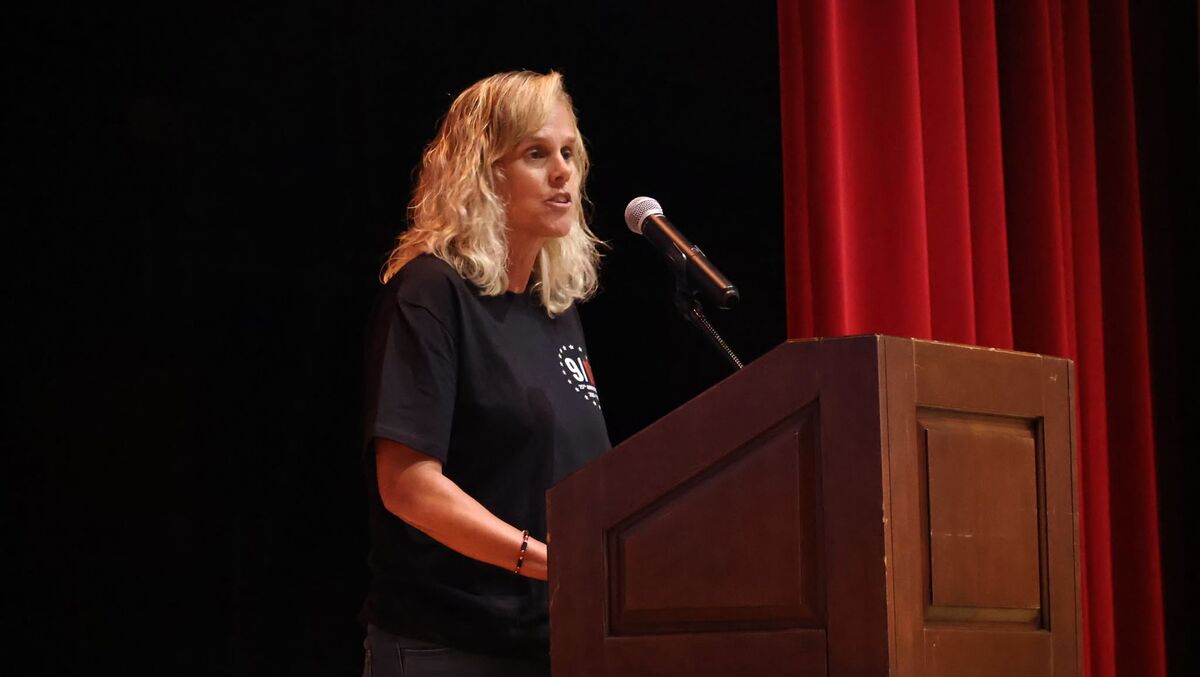
Camden High School Social Studies teacher Jessica Harney closed the program by emphasizing the importance of telling these stories.
“History is built on the real lived experiences of ordinary people who live through extraordinary times,” she said. “We all have a story to tell, and all of our stories mean something to someone. None of our speakers today were in New York City on the day of September 11th, but each story represents some aspect of the American response to 9-11. We can see bravery in each of our speakers' stories. Their stories represent the unique lens and perspective that we each bring to any given situation, whether near or far from the attacks. These stories still matter, and we are so thankful for the gift of hearing their stories.”
She challenged students to do their own part in ensuring that the nation truly never forgets by preserving historical narratives and oral histories - stories that need to be collected now so that they can be told again long after we’re gone.
“Step up, ask big questions, listen to the powerful stories around you, and leave your mark on our community,” she said. “By interviewing community members, family, and local leaders, listening to their memories, their struggles, and their reflections, We're capturing stories that might otherwise be lost. Collecting oral histories bridges the gap between generations, teaches us empathy, gives depth to historical events, and it ensures that our collective memory represents the true diverse voices of our community.”
Working on collecting oral histories is a component of the New York State Seal of Civic Readiness, which received a formal launch by Harney to wrap up the program. A small group within the Class of 2026 received this distinction on their diplomas, and she hopes that debuting it to a larger audience will increase interest in the years ahead.
Above all else, she just wants to make sure those stories, like the ones students heard in this assembly, continue to be told for years to come.